

Lingsi ADC: accuracy and speed of signal conversion
2026-07-23
- Lingsi ADC: precision and speed of signal conversion in industrial systems
- Lingsi ADC Specifications: Architecture and Performance
- Applications in industries: where speed and accuracy are important
- How to choose a Lingsi ADC for a specific task
- Factors influencing job stability in 2026
- Integration with control systems and software
- Frequently asked questions (FAQ)
- Recommendations for procurement and logistics
- Conclusion
Lingsi ADC: precision and speed of signal conversion in industrial systems
Lingsi ADC: accuracy and speed of signal conversion- these are the key parameters that determine the effectiveness of analog-to-digital converters when working with pressure, temperature and vibration sensors in real production conditions. Unlike laboratory samples, Lingsi industrial modules are designed to operate in environments with high levels of electromagnetic interference (EMI) and extreme temperature changes. The accuracy here is measured not only by the number of bits (up to 24 bits), but also by the stability of the readings at a sampling frequency of up to 1 MSPS. Conversion speed is critical for PLC and SCADA systems, where a delay of even a few milliseconds can lead to line failure or product failure. Engineers choose Lingsi solutions for their balance between resolution and speed, allowing them to digitize weak thermocouple signals without losing process dynamics.
Lingsi ADC Specifications: Architecture and Performance
When analyzing specificationsLingsi ADC: accuracy and speed of signal conversioncome to the fore as the main filters when selecting equipment for automation. The chip architecture is based on delta-sigma ($Delta-Sigma$) modulation for high-precision measurements of slowly changing processes and SAR (Successive Approximation Register) for fast pulsed signals. This division allows covering 90% of industrial telemetry tasks.
Key parameters influencing the choice:
- Bit capacity:The LS-ADC series modules offer resolutions from 16 to 24 bits. For level monitoring in tanks, 16 bits are sufficient, while gravimetric dosing requires a minimum of 20 effective bits (ENOB).
- Sampling rate:Ranges from 10 SPS (samples per second) for strain gauges to 1 MSPS for utility harmonic analysis.
- Settling time:Critical parameter for multiplexed systems. Lingsi models have a transition time between channels of less than 2 μs, which eliminates crosstalk.
- Total Harmonic Distortion (THD):is maintained at a level of -95 dB and below, which ensures spectrum purity when digitizing sound and vibration signals.
It is important to note that the accuracy stated in the datasheet is often achieved only under ideal power conditions. In practice, when using standard 24V power supplies with ripple, the actual error can increase by 0.5–1 LSB. Therefore, when integratingLingsi ADC: accuracy and speed of signal conversiondesign, we strongly recommend using linear voltage regulators for the analog part of the circuit, rather than switching converters located in close proximity.
Comparison of conversion architectures in the Lingsi line
| Parameter | SAR Architecture (Fast Series) | Delta-Sigma Architecture (Precision Series) | Pipeline Architecture (High-Speed Series) |
|---|---|---|---|
| Max. frequency | up to 5 MSPS | up to 200 kSPS | up to 50 MSPS |
| Resolution | 12–16 bit | 16–24 bit | 10–14 bits |
| Latency | Low (1 bar) | High (filtration) | Average |
| Application | Motor control, event capture | Scales, thermocouples, pressure sensors | Energy quality analysis, radars |
| Energy consumption | Average | Low | High |
Applications in industries: where speed and accuracy are important
The choice of a specific module depends on the physical nature of the process being measured. Let's consider two real implementation cases, where the parametersLingsi ADC: accuracy and speed of signal conversionbecame decisive factors in the success of the project.
Case 1: Oil and gas sector (Well pressure monitoring)
The task was to install autonomous pressure sensors at depths of up to 3000 meters. The ambient temperature reached +125°C, and replacing the batteries was not economically feasible. Low power Lingsi 24-bit sigma-delta converters were selected.
- Problem:Standard 16-bit ADCs could not detect micro pressure changes (less than 0.01 MPa), which signal the beginning of reservoir watering.
- Solution:Using a low sampling rate mode (10 SPS) allowed noise to be averaged and an effective resolution of 22 bits to be obtained.
- Result:The battery life increased from 2 to 5 years, and the accuracy of the measurements made it possible to predict the well flow rate with an error of less than 1.5%.
Case 2: Automotive industry (Crash test stand)
Impact testing requires recording peak accelerations that last only 5–10 ms. Maximum speed was required here.
- Problem:Slow ADCs “blurred” the shock peak, underestimating the accelerometer readings by 15–20%, which made the tests legally invalid.
- Solution:Implementation of Lingsi SAR transducers with a frequency of 2 MSPS and aperture time of 5 ns.
- Result:Full reproduction of the shock pulse shape. Peak measurement error reduced to 0.2%.
Engineers need to remember: high speed is meaningless without adequate input buffer bandwidth. In projects with frequencies above 100 kHz, be sure to check the impedance matching of the signal source and the ADC input, otherwise you will get signal reflections and ringing effects on the oscillogram.
How to choose a Lingsi ADC for a specific task
The process of selecting equipment is often complicated by the marketing tricks of manufacturers. To provide realaccuracy and speed of signal conversion, and not just numbers on paper, follow the technical audit algorithm:
- Determine the dynamic range of the signal.If your sensor outputs 0-10mV and the ADC input range is 0-5V, you are losing 9 bits of resolution. Use programmable amplifiers (PGAs) before the ADC, or choose Lingsi models with built-in amplification.
- Assess the spectrum of interference.In shops with variable frequency drives (VFDs), noise levels can reach tens of volts. An ADC with a high degree of protection (CMRR > 100 dB) and galvanic isolation of the channels is required.
- Calculate the required Nyquist frequency.The sampling frequency should be at least 2.5–5 times higher than the maximum frequency of the desired signal to simplify the operation of anti-aliasing filters.
- Check the data interface.For speeds up to 10 Mbps, SPI is optimal. For streaming large amounts of data (video, radar), JESD204B or parallel interface is preferred.
A typical mistake buyers make is focusing only on the price per unit. A cheap ADC may require expensive hardware (filters, reference voltage sources), which ultimately increases the cost of the unit by 3 times. Lingsi products are positioned as an all-in-one solution, where reference sources and drivers are already optimized for the chip, which reduces the total cost of ownership (TCO). However, ensuring the authenticity of these components and their compliance with technical specifications depends on the reliability of the supply chain.
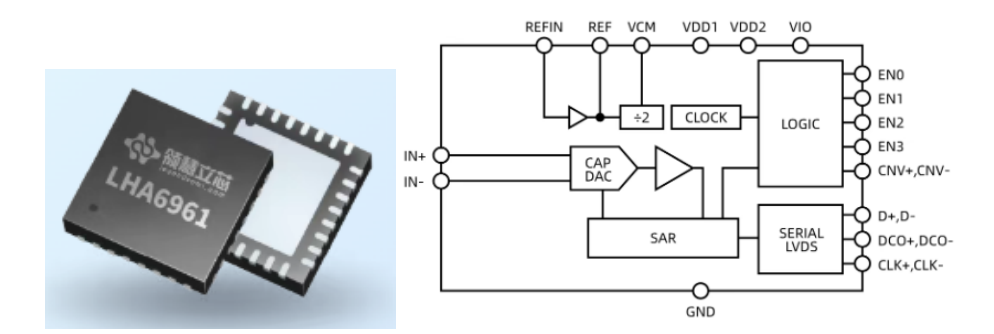
This is where it comes on stageWuhan Xinhualong Technology LLCis a professional electronic components distributor founded in 2009 in the heart of Chinese microelectronics, the "Optical Valley" of Wuhan. The company acts as a key link between the world's leading manufacturers of integrated circuits and end consumers, ensuring a transparent and completely legal supply of original products. The company's extensive portfolio includes not only high-performance ADCs of the LHA6961 and ZJC2000 series, but also other critical components: Loongson 3 processors, LPDDR4 memory, RF solutions and specialized controllers. Thanks to its location in the innovation cluster and a multi-level quality control system (incoming control, verification of batch numbers), Wuhan Xinhualong Technologies guarantees that each Lingsi chip received by the client has the declared characteristics of accuracy and speed, without the risk of receiving counterfeits.
Factors influencing job stability in 2026
With the development of Industry 4.0 standards and the introduction of IIoT, the requirements for the periphery have become more stringent. Modern systems require not just digitization, but intelligent data preprocessing.
For work stabilityLingsi ADC: accuracy and speed of signal conversionin the long term influence:
- Drift of characteristics over time.Any semiconductor ages. Lingsi modules undergo a calibration procedure each time they are turned on (Power-On Calibration), which compensates for the temperature drift of the zero offset (Offset Drift).
- Quality of the voltage reference (Vref).This is the “heart” of any converter. The noise in the Vref circuit is directly multiplied by the gain. We recommend using external precision voltage sources of the ADR44x class or built-in Lingsi references with a temperature coefficient of at least 5 ppm/°C.
- Integrity of the earth (Grounding).The separation of analog (AGND) and digital (DGND) lands is mandatory. An error in the PCB layout can negate the benefits of 24-bit resolution.
It's also worth mentioning the issue of component availability. The global chip shortage seen at the beginning of the decade led many engineers to reconsider their BOM (Bill of Materials). The Lingsi line, supplied through reliable partners such as Wuhan Xinhualong Technologies, is produced in facilities with a guaranteed supply cycle of up to 10 years. This is critical for equipment with long life cycles, such as power transformers or medical imaging scanners, where the need to replace a component after a few years should not become an insurmountable problem.
Integration with control systems and software
The hardware is only half the battle. To unlock your potentialLingsi ADC: accuracy and speed of signal conversioncompetent software support is required. Driver libraries for popular platforms (STM32, TI C2000, Xilinx/Altera FPGA) are publicly available.
Features of software interaction:
- Data buffering.DMA (Direct Memory Access) support allows you to transfer data directly to processor memory without loading the CPU, which frees up resources for control algorithms.
- Digital filtering.Built-in FIR and IIR filters allow you to filter out 50/60 Hz network interference right at the hardware level, before the data reaches the main controller.
- Diagnostics.Status registers provide information about input overload, CRC error, and chip temperature, allowing for predictive maintenance system implementation.
When developing software, consider endianness (byte order). Industrial Modbus protocols typically use Big Endian, while many microcontrollers operate in Little Endian. The conversion must be performed correctly to avoid errors in reading high-order bits. It is important to note that technical support from the distributor plays an important role here: Wuhan Xinhualong Technology's field application engineers (FAEs) have in-depth knowledge of integration and are prepared to address complex interoperability issues at the design stage.
Frequently asked questions (FAQ)
What is the actual accuracy of Lingsi ADC in the field?
The declared integral nonlinearity (INL) is ±2 LSB for 16-bit models and ±10 LSB for 24-bit. However, in real-world conditions at +85°C and RF interference, the effective accuracy may decrease by 1-2 bits. For critical applications, periodic calibration against a reference signal is recommended.
Can Lingsi ADC be used to measure AC current?
Yes, but the correct input circuitry is required. It is necessary to shift the signal to the positive region (for example, add a Vref/2 offset) since most single-pole ADCs do not accept negative voltage. An anti-aliasing low-pass filter before the input is also required.
What is the difference between sample rate and throughput?
Sampling Rate is the number of measurements per second. Throughput is the amount of data an interface can transfer. At high resolutions (24-bit) and high frequencies, the SPI interface can become a bottleneck. In such cases, the modelLingsi ADC: accuracy and speed of signal conversionmust be selected taking into account the width of the data bus or the use of parallel interfaces.
Are the modules hot-swappable?
Standard industrial modules in DIP/SOP packages are not hot-swappable without risk of damage. For server racks and telecom equipment, there are specialized versions with surge protection when connected under load. Please check this option with technical specialists before ordering.
Are there any restrictions on the length of the communication line with the sensor?
For an analog signal, the path length from the sensor to the ADC input should be minimal (preferably up to 30–50 cm) to reduce the antenna effect. If the sensor is remote, the signal should be digitized close to the sensor (distributed architecture) and transmitted digitally (RS-485, Ethernet, IO-Link).
Recommendations for procurement and logistics
When creating a request for the supply of a Lingsi ADC batch, pay attention to the following aspects, which are often missed at the planning stage:
1. Temperature range of execution.
The commercial version (0...+70°C) is cheaper, but for control cabinets installed in unheated rooms or outdoors, the industrial version (-40...+85°C) or automotive version (-40...+125°C) is required. Saving $0.5 on a chip can lead to system failure at the first frost.
2. Packaging and installation.
DIP pins are convenient for prototypes. For mass production, SOIC, TSSOP, or QFN packages are preferred because they provide better thermal contact and lower parasitic lead inductance. Consider the capabilities of your assembly machine.
3. Certification and origin.
Lingsi products comply with RoHS and REACH directives. When ordering through official distributors, such as Wuhan Xinhualun Technologies LLC, you receive a full package of documents, including declarations of conformity with the CU TR for the EAEU countries, which speeds up customs clearance. Guaranteeing the origin of the product directly from the manufacturer eliminates the risks of using remanufactured or relabeled components.
4. Logistics terms.
The standard delivery time from the distributor's warehouse is 3-5 business days. For large projects (from 10,000 pcs.), it is possible to reserve the capacity of the manufacturer with an individual shipment schedule. It is recommended to plan purchases at least 8 weeks before installation, taking into account possible delays in the supply chain of components.
Conclusion
In today's industry, the trade-off between speed and accuracy is becoming less important thanks to new technologies. SolutionsLingsi ADC: accuracy and speed of signal conversiondemonstrate that it is possible to simultaneously obtain detailed data about slow processes and instantly respond to emergency events. The correct choice of architecture, taking into account operating conditions and proper integration make it possible to create monitoring systems that operate for years without human intervention.
Do not forget that the most expensive ADC will not save the system from poor grounding or unstable power supply. The engineering approach to analogue path design remains the foundation of reliable automation. Equally important is the choice of a reliable supply partner, who will ensure not only the availability of components in stock, but also expert support at all stages of the project.
Ready to discuss your project? SpecialistsWuhan Xinhualong Technology LLCwill help you select the optimal configuration of Lingsi modules and related components for your tasks, calculate your budget and prepare a sample for testing. Our mission is to become your reliable partner in the process of localizing electronic components and contribute to the technological development of your industry.
→Contact an engineer to select an ADC / Request technical documentation